

📝 Blog Summary
This blog explains how modern IVR systems help businesses improve customer experience, reduce operational costs, and scale support efficiently in 2026. It covers essential IVR design best practices, key features, and emerging trends, including AI-driven automation, cloud-based IVR, and omnichannel integration. By following the right IVR strategy, businesses can build smarter, more flexible call flows that support long-term growth and better customer engagement.
Interactive Voice Response (IVR) systems have become a cornerstone of modern business communication. A well-designed business IVR setup helps companies streamline customer interactions, reduce response times, and simplify call management. Whether you’re a startup looking for IVR solution Providers for the small businesses or an enterprise aiming for advanced IVR for business scalability, this guide will walk you through the essentials of IVR software development, from design best practices to deployment strategies.
What Is IVR Software?
IVR software is an automated phone system that interacts with callers, gathers input, and routes calls to the appropriate department or self-service option. Integrating databases and CRM allows businesses to handle high call volumes without compromising customer service quality. Many companies implement multi-level IVR solutions for enterprises to manage complex workflows and provide structured navigation for customers.
Why Do Businesses Need IVR Software?
Interactive Voice Response software has emerged as a powerful tool, especially when implemented as a modern business IVR system. Businesses adopting call center IVR design best practices can significantly reduce operational costs.
By following IVR design best practices in design, companies can enhance customer experience, optimize workflows, and ensure every interaction is smooth and intuitive.
Therefore, here’s why businesses, large and small, should invest in an IVR system:
1. Enhance Customer Experience
IVR systems streamline customer interactions by offering self-service options that enable callers to resolve issues quickly and conveniently. Whether checking account details, tracking orders, or scheduling appointments, IVR systems reduce the need for live agent intervention while keeping customers satisfied.
2. Reduce Operational Costs
By automating repetitive tasks and call handling, IVR systems significantly lower the cost of maintaining large customer service teams. Businesses can allocate live agents to handle more complex inquiries, thereby optimizing resource allocation.
3. Improve Call Management and Efficiency
With IVR systems, handling high call centers improves both efficiency and customer satisfaction. Investing in structured IVR development enables small businesses to scale their support operations without adding extra agents. Features such as intelligent call routing and prioritization ensure customers are connected to the correct department or agent without unnecessary transfers.
4. Task Automation
Live agents often spend valuable time addressing repetitive queries. IVR software automates these tasks, allowing agents to focus on resolving complex issues and improving productivity and morale. For example, self-service account balance or order tracking options free up agents to focus on higher-value tasks.
5. Increase Scalability for Growing Businesses
Custom IVR software development ensures businesses can scale their customer service operations seamlessly. Whether you’re a startup or an enterprise, IVR systems adapt to growing customer bases and changing needs.
6. Support Data-Driven Decisions
Modern IVR systems provide analytics and reporting tools to monitor call patterns, identify customer pain points, and optimize workflows. These insights help businesses improve their processes and better understand customer behavior.
7. Personalize Customer Interactions
Integrating IVR systems with CRMs enables personalized interactions based on caller history and preferences. This improves the caller experience and strengthens customer loyalty.
8. Future-Proof Business Communication
Investing in an advanced IVR system positions your business for future growth. As technology evolves, IVR software can integrate with AI, machine learning, and other innovations to offer cutting-edge features such as sentiment analysis and predictive call routing.
IVR systems are no longer a luxury but a necessity for businesses striving to deliver exceptional customer experiences while staying competitive. If you’re exploring IVR solutions for small businesses or building an enterprise-grade system, the benefits of adopting this technology are clear and impactful.
What are the Key Features of IVR Systems?
Interactive Voice Response (IVR) systems are indispensable for businesses seeking efficient, automated customer communication. Here are the key features of IVR systems that make them essential for businesses.
- Multi-Language Support: Enable seamless communication for global or diverse audiences, ensuring customers can interact in their preferred language.
- Customizable Menus: Tailored options allow businesses to design intuitive navigation, including multi-level IVR solutions for businesses that help segment customer journeys more efficiently.
- CRM Integration: Access customer data in real-time, providing personalized service based on caller history and preferences. Such integration elevates the effectiveness of IVR for business systems.
- Self-Service Options: Empower customers to resolve common issues, like checking their order status or account balances. This reduces the need for live agents and improves efficiency.
- Real-Time Analytics: Track call performance, identify pain points, and optimize workflows. Analytics enhance decision-making for IVR deployment in dynamic environments.
- Call Routing: Use intelligent algorithms to connect callers to the appropriate department or agent, minimizing transfer times and enhancing satisfaction.
By leveraging these features, businesses can develop cost-effective, scalable, and customer-friendly IVR solutions that enhance service delivery and efficiency.
IVR Design Best Practices – Call Flow, Menu Structure, and Routing
Creating an intuitive, user-friendly business phone IVR system is crucial to success. Whether you’re a startup or an enterprise, a complete guide to IVR solutions and benefits is essential for understanding key IVR design principles.
As organizations expand, many adopt multi-level IVR solutions for businesses to simplify call flows and guide customers through structured service paths. This ensures that every inquiry reaches the correct function without unnecessary transfers.
Follow these IVR design best practices to optimize user experience:
1. Keep Menus Simple
Avoid complex, multi-layered menus. Limit options to 3–5 per level and ensure descriptions are concise.
Example:
“Press 1 to reach our Sales team, 2 for Customer Support, and 3 for VoIP Billing.”
2. Use Natural Language Processing (NLP)
Incorporating NLP into your IVR for small businesses ensures callers can interact naturally, making the system more intuitive. Always maintain DTMF keypad input as a fallback alongside speech recognition. Callers on poor audio connections or noisy environments need a reliable alternative, and some callers simply prefer pressing buttons over speaking.
3. Prioritize Call Routing
Efficient call routing cuts down wait times and improves resolution rates. Leverage intelligent call distribution algorithms to connect callers to the right agents.
Example:
“A customer calling about billing is directly routed to the Accounts Department, while product inquiries go straight to Sales, no transfers needed.”
4. Personalize Caller Interactions
Utilize CRM data to greet customers by name or provide tailored options based on their account history.
Example:
“Welcome back, John! Press 1 for account details or 2 for recent transactions.”
5. Enable Easy Exit Options
Let users connect with a live agent quickly if they encounter difficulties.
Example:
“Press 0 anytime to speak with an agent.”
6. Optimize for Mobile Devices
Ensure your IVR system accommodates smartphone users by offering touch-screen-friendly menus and responsive voice commands.
Example:
“Instead of long numeric options, mobile users can simply tap ‘Support’ on their screen or say ‘Support’ to be routed instantly.”
By implementing theseb, businesses can create efficient, user-friendly systems that ensure seamless communication and higher customer satisfaction. A well-designed IVR system improves operational efficiency and strengthens your brand’s reputation for exceptional service.
How to Measure IVR Performance
- Containment rate – percentage of calls resolved within IVR without agent transfer
- IVR abandonment rate – callers who hang up while still in the IVR menu
- Dropout points – specific menu levels where callers exit
- Task completion rate – percentage of self-service attempts that succeed
- Zero-out rate – callers bypassing menus to reach an agent
- First contact resolution (FCR) – issues resolved on the first call
What Is Canvas-Based IVR and How Can It Improve Your Call Flow Design?
Modern IVR systems are increasingly adopting canvas-based design tools to simplify call flow creation. Instead of manually coding menus, routing logic, and automation steps, businesses can visually design workflows using an intuitive drag-and-drop interface. This approach allows teams, technical or non-technical, to quickly build, modify, and deploy IVR systems with minimal errors.
Canvas-based IVR is particularly beneficial for growing businesses because it enables:
- Rapid Deployment: Visual workflows speed up implementation, reducing time-to-market for new IVR features.
- Easy Updates: Adjust menus, routing rules, and automated actions on the fly without rewriting code.
- Error Reduction: A clear visual representation of call flows helps identify and resolve bottlenecks before launch.
- Optimized Caller Experience: Businesses can design logical, intuitive navigation paths that reduce caller frustration and improve satisfaction.
- Alignment with IVR Best Practices in Design: Visual call flows help ensure menus are concise, routing is efficient, and self-service options are clearly presented.
By leveraging canvas-based IVR, businesses can combine the efficiency of automation with the clarity of visual planning, ensuring their IVR systems remain adaptable, user-friendly, and scalable as the organization grows.
How to Get the Best IVR System for Small Businesses?
Developing and deploying an IVR system tailored to small businesses requires a strategic approach. Here’s how to start:
Step 1: Assess Business Needs
Identify the primary functions your IVR system should support, such as appointment scheduling, payment processing, or customer support.
Step 2: Choose the Right Platform
Select a scalable and cost-effective platform. Cloud-based call center solutions are ideal for small businesses because of their lower upfront costs and ease of maintenance.
Step 3: Design the Workflow
Map out the customer journey from call initiation to resolution to ensure a seamless, logical flow.
Step 4: Select Development Tools
Use development frameworks and APIs compatible with your telephony system. Popular tools include Twilio, Asterisk, and Genesys.
Step 5: Test and Deploy
Conduct rigorous testing to identify bugs or usability issues before deploying the system.
By following these steps, small businesses can implement an efficient and user-friendly IVR system that enhances customer satisfaction while staying within budget. Investing in the best IVR solutions for small businesses ensures scalability, professionalism, and long-term operational success.
How to Choose the Right IVR Solution for a Growing Business?
With numerous options available, selecting the right IVR software can be daunting. If you’re wondering how to choose the right IVR solution for a growing business, here’s what to consider:
1. Scalability
Pick solutions that grow with your business, whether you add more lines or support complex workflows. Ensure the system can seamlessly handle seasonal call spikes and future business expansions.
2. Customizability
Ensure the software allows for tailored menu options, languages, and branding. This flexibility enables businesses to design a system that goes well with their unique operational needs and customer expectations.
3. Integration Capabilities
Look for IVR systems that integrate with CRMs, ERP systems, and analytics tools. Integration ensures smoother workflows and provides valuable insights for better decision-making.
4. User Experience
Choose software with an intuitive design interface and natural language capabilities. A user-friendly IVR system reduces caller frustration and enhances overall customer satisfaction.
This becomes even more important when configuring a business phone IVR, where clarity and ease of navigation directly impact customer satisfaction.
5. Cost-Effectiveness
Evaluate both upfront and ongoing costs, keeping budget constraints in mind. Compare pricing models and opt for solutions that deliver maximum value without overextending resources.
By focusing on scalability, integration, and user experience, businesses can select advanced IVR software solutions that align with their goals and deliver exceptional customer service. The right choice ensures long-term efficiency, adaptability, and customer satisfaction.
What are the IVR Software Development Challenges and Ways to Overcome Them?
While IVR software development offers significant benefits, it also presents challenges. Strategic IVR development ensures scalability, helping small businesses expand their customer support capabilities over time. Addressing these effectively ensures a successful and user-friendly system:
1. Complex Integration
Connecting an IVR system with existing CRMs, databases, and telephony infrastructure can be challenging. Misalignment during integration may lead to data consistency or system incompatibilities.
Solution: Partner with experienced developers skilled in integrating IVR systems with a range of technologies. Utilize APIs and middleware to bridge gaps and ensure smooth data flow. Testing it in real-world scenarios before the successful deployment of the IVR system can preempt potential integration issues.
2. Cost Concerns
Custom IVR solutions often involve high upfront costs, which can be challenging for small businesses. Software licenses, infrastructure, and maintenance expenses add to the financial burden.
Solution: Consider cloud-based IVR solutions for small businesses as a cost-effective alternative to on-premises systems. Evaluate pricing plans and prioritize features critical to your business to avoid overspending on unnecessary functionalities.
3. User Frustration
Poorly designed IVR menus, unclear navigation, and long wait times can frustrate callers and lead to negative customer experiences. Frequent misrouted calls or inability to reach live agents further compound the issue.
Solution: Adhere to call center IVR best practices by creating intuitive menus with clear instructions and minimal layers. Offer callers easy access to live agents when needed. Use real-time monitoring and customer feedback to refine workflows continuously.
Businesses can develop robust, efficient, and customer-friendly IVR software solutions that improve customer engagement and operational efficiency by addressing these challenges with strategic planning and the right tools.
What Are the Emerging Trends in IVR for 2026?
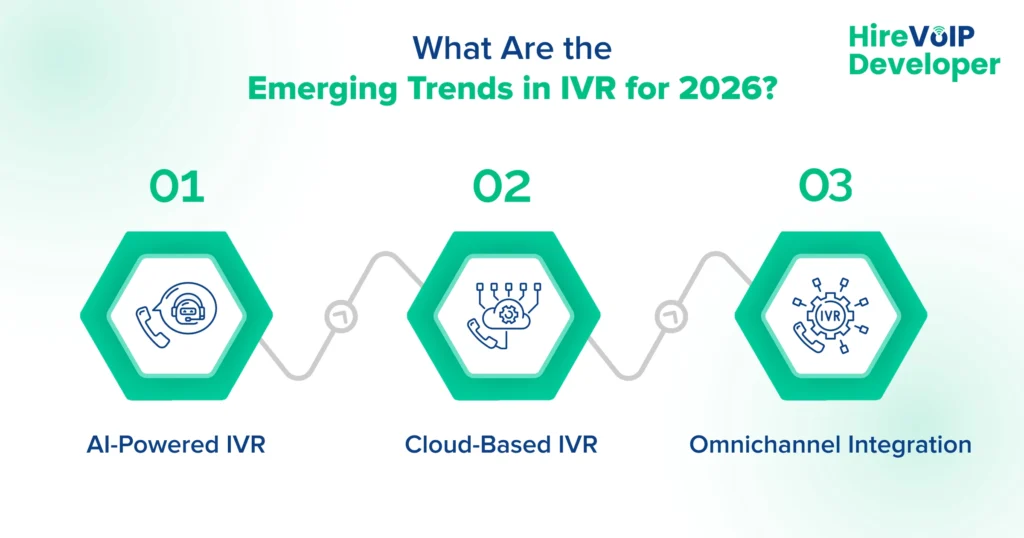
Emerging IVR software development trends are revolutionizing how businesses communicate with customers, improving efficiency and customer satisfaction.
1. AI-Powered IVR
AI-driven systems offer advanced features like voice recognition, predictive call routing, and real-time feedback. These systems can understand natural language, making interactions more intuitive and user-friendly. With AI, businesses can automate complex workflows, analyze sentiment, and deliver highly personalized customer experiences. Incorporating AI features is most effective when aligned with established IVR best practices, ensuring a smooth user experience.
2. Cloud-Based IVR
Cloud solutions provide unmatched scalability and cost savings, making them a great choice for businesses of all sizes. They eliminate the need for extensive infrastructure, ensuring quick IVR deployment and hassle-free updates. Cloud IVR can quickly scale to handle higher call volumes as businesses grow, making it ideal for dynamic industries.
3. Omnichannel Integration
Future IVR systems will seamlessly integrate with other communication channels, ensuring a unified customer experience. This includes connecting phone, email, chat, and social media interactions, allowing customers to switch channels effortlessly. Such integration gives businesses a holistic view of customer interactions and ensures platform continuity.
As technology evolves, IVR systems will become more innovative, adaptable, and central to customer service strategies. Businesses that embrace these innovations will be better positioned to deliver superior experiences and maintain a competitive edge.
Deliver Better Customer Support With Intelligent IVR.
IVR systems are transformative tools for businesses, offering streamlined customer interactions, cost savings, and scalability. They simplify complex communication workflows, reduce operational costs, and ensure 24/7 customer support availability.
Whether exploring IVR solutions for small businesses or designing enterprise-grade systems, adopting IVR design best practices and leveraging innovative technologies can set you apart in a competitive market.
An IVR system can enhance customer satisfaction and drive operational efficiency when implemented effectively. Even minor adjustments, when guided by IVR best practices, can reduce caller frustration and improve navigation.
Visit Hire VoIP Developer to learn more about how our expertise can elevate your communication strategy and help you achieve your business goals. Get in touch with us today!